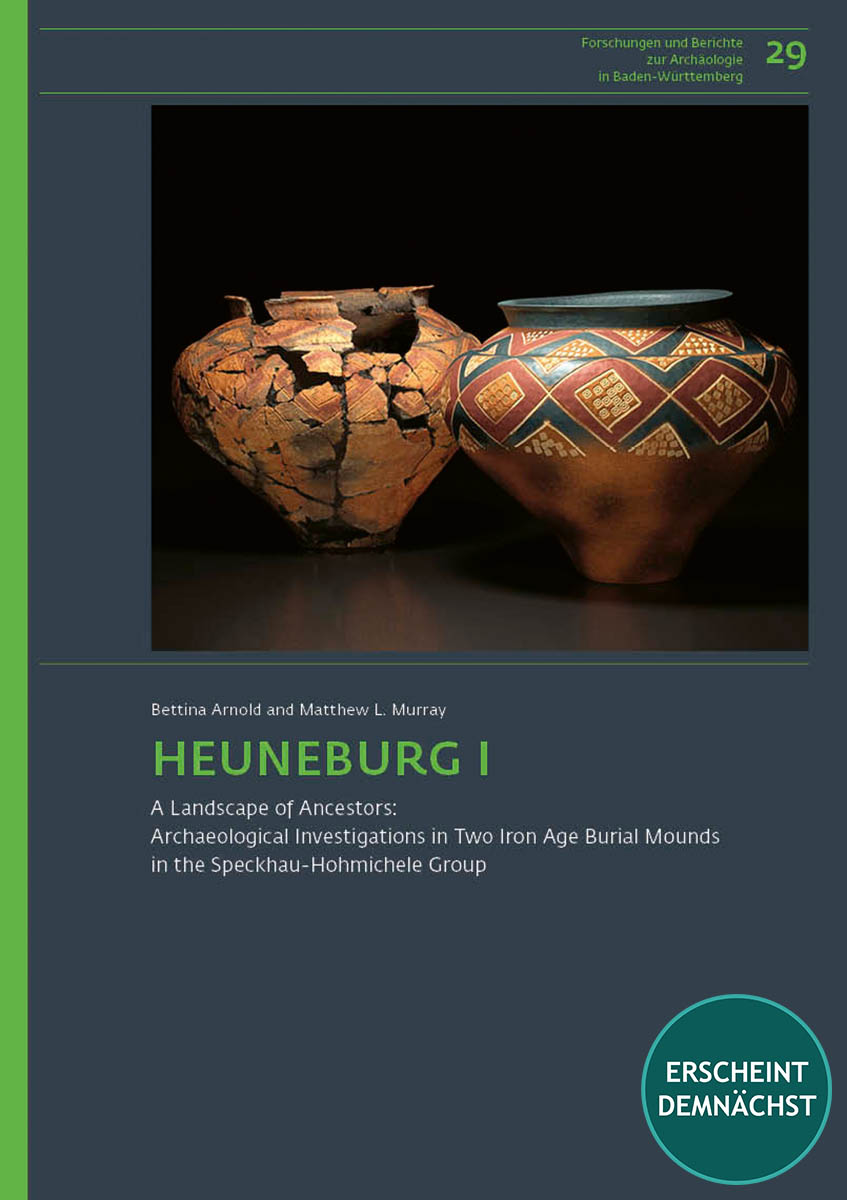
Between 1999 and 2002, the first systematic investigations in two tumuli under 50 meters in diameter near the Heuneburg hillfort were carried out. They provided the first evidence for Early Iron Age mortuary activity predating the founding of the Heuneburg and gave information about how society was organized at a critical time in the evolution of social complexity. The project pioneered the use of CT-scan technology in the analysis of fragile grave goods. The material culture links the “Speckhau” population with northern Italy, Britain and the Iberian Peninsula.
In 1999, an American team began excavation of an Early Iron Age burial mound in the “Speckhau” tumulus group near the internationally renowned Heuneburg hillfort on the upper Danube River in Baden-Württemberg as part of a research initiative focused on Early Iron Age mortuary practices. The results of three field seasons of excavation by the “Landscape of Ancestors” project in two 20-meter diameter burial mounds are presented in this publication. There are hundreds of burial mounds in the vicinity of the Heuneburg, but until the “Landscape of Ancestors” project, no systematic investigations had been conducted in mounds under 50 meters in diameter. Such mounds provide an important source of information about how society was organized at a critical time in the evolution of social complexity in the region, which was increasingly connected with cultural developments in other areas of Europe. The project produced the first evidence for Early Iron Age mortuary activity predating the founding of the Heuneburg, beginning ca. 700 BCE and extending well into La Tène A.
Post-excavation innovations in materials analysis included the first use of CT-scan technology in the examination of fragile metal and organic grave goods that revealed previously unknown details of the technology used in manufacturing personal ornament and weapons as well as their precise placement in the grave. Other innovations included 3-D reconstruction of ceramic vessels to facilitate scientific analysis and visualization.
The material culture recovered from 21 inhumation graves links the “Speckhau” population with northern Italy, Britain and the Iberian Peninsula, indicating that such external connections were not limited to the elites in central chambers in the better-known mega-mounds of the region. This volume contributes to an ongoing reimagining of the Early Iron Age cemetery as a place of multiscalar activities with remarkably diverse individual and group expressions and materialities.
Bettina Arnold obtained her BA in Archaeology from Yale University and her MA and PhD degrees in Anthropology from Harvard University. She is Professor of Anthropology at the University of Wisconsin-Milwaukee and Adjunct Curator of European Archaeology at the Milwaukee Public Museum. Her research interests include the archaeological interpretation of complex societies as reflected in mortuary contexts and alcoholic beverages; the archaeology of gender; and the socio-political history of archaeology and museums in 19th and 20th century nationalist and ethnic movements in Europe and the United States. She published a ground-breaking article on the use and abuse of archaeology for political purposes in Nazi Germany in Antiquity in 1990 that has been reprinted repeatedly and has been featured in documentaries dealing with the Iron Age Celts of Europe and National Socialist archaeology in Germany. Recent publications include a 2025 co-edited volume with Springer entitled Connecting People and Ideas: Networks and Networking in Archaeology. She is a co-editor of the Cambridge University Press Elements in the Archaeology of Europe series, which is co-sponsored by the European Association of Archaeologists.
Matthew Leigh Murray completed a BA in Anthropology at the University of Connecticut. He received an MA and PhD in Anthropology from Harvard University. He is Instructional Professor in Anthropology at the University of Mississippi. He began his European archaeology career excavating Late Bronze Age and Early Iron Graves at Uttendorf and Dürrnberg bei Hallein in Austria and restoring burial ceramics from the excavations. As a graduate student, he published one of the first bone chemistry studies of the diet and status in an Early Iron Age burial community in southeastern Europe and has investigated Bronze Age, Iron Age, and Roman sites across southern Germany. He was an early advocate for the use of critical social geography in the study of Iron Age landscapes and Bronze Age to Iron Age sociocultural change and has championed multiscalar analysis of mortuary practices in Early Iron Age cemeteries. His current research is focused on mortuary archaeology, prehistoric landscapes, cultural change, and archaeological resource management in southeastern Germany.
Die „Forschungen und Berichte zur Archäologie in Baden-Württemberg “ erscheinen ab 2016 als neue, hochwertige monographische Reihe des Landesamtes für Denkmalpflege im Regierungspräsidium Stuttgart. Die neue Reihe vereint die drei etablierten archäologischen Reihen des Landesamts (Forschungen und Berichte zur Vor- und Frühgeschichte, Forschungen und Berichte der Archäologie des Mittelalters sowie die Materialhefte zur Archäologie), die sich inzwischen inhaltlich und in ihrem Umfang kaum mehr voneinander unterscheiden, in einem neuen, modernen Design.
In der Reihe erscheinen in erster Linie Monographien, daneben aber auch Sammelwerke wie z. B. Tagungsbände. Die publizierten Forschungsergebnisse resultieren vor allem aus archäologischen Ausgrabungen der Landesdenkmalpflege, die häufig im Rahmen von akademischen Abschlussarbeiten aufgearbeitet wurden. Thematisch wird die Archäologie in ihrer gesamten zeitlichen Tiefe abgedeckt, von der Vor- und Frühgeschichte über die Provinzialrömische Geschichte und das frühe Mittelalter bis zur Archäologie des Mittelalters und der Neuzeit. Die neue Reihe ist das wissenschaftliche Aushängeschild der archäologischen Denkmalpflege in Baden-Württemberg.