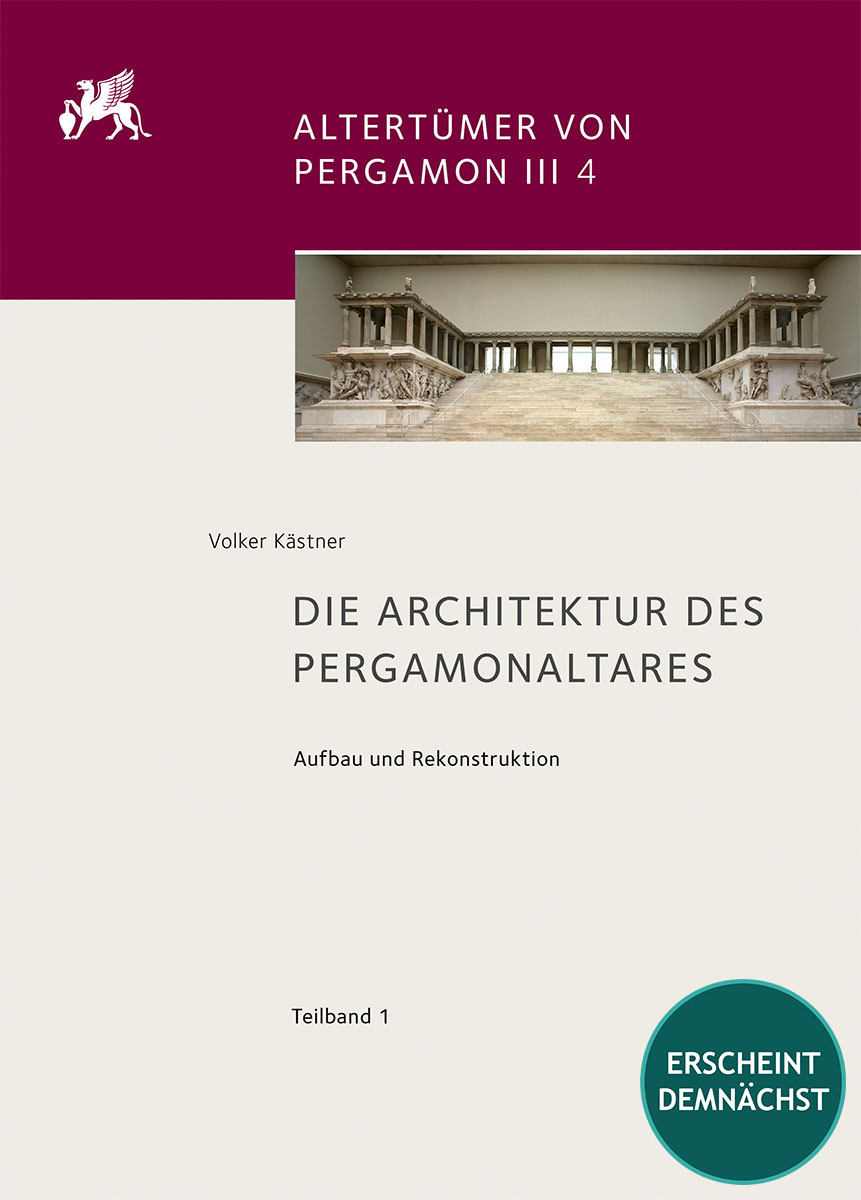
Der Pergamonaltar ist ein berühmtes Ausstellungsobjekten auf der Berliner Museumsinsel. Dank einer langjährigen Kooperation der Antikensammlung der Staatlichen Museen zu Berlin mit der Pergamon-Grabung des DAI konnte seine Architektur im Berliner Museum und am Ausgrabungsort erstmals umfassend dokumentiert werden. Der vorliegende Band der Altertümer von Pergamon erfasst so etwa 1170 Bauglieder des Altares in Zeichnung, Fotografie und Beschreibung. Dieses Fundmaterial wurde vom Stufenbau bis zum Dach systematisch neu gegliedert. Dabei half das antike Versatzmarkensystems die Vorstellungen vom Aufbau des Altars zu präzisieren. Zusammen mit der Publikation zum Altarfundament und den metronomischen Studien von Manfred Klinkott ergibt sich so ein Gesamtbild des Bauwerkes.
This publication contains the documentation of more than 1170 architectural elements in the form of drawings, photographs, and descriptions that were used for the reconstruction of the Pergamon Altar. These include in particular the numerous architectural elements that remained in the Bergama Museum and at the excavation site, insofar as they could be identified, as well as all the fragments that are now in Berlin and that originated from the formal division of finds with the Ottoman state for the old museum excavation (1878-1886). This publication thus continues and completes the work on the Pergamon Altar begun by Manfred Klinkott in AvP III.3, where the foundations and metrological studies were presented. The present documentation and the associated studies on the architecture of this unique monument of the Hellenistic period in Asia Minor were made possible by a cooperation between the Collection of Classical Antiquities of the Staatliche Museen zu Berlin and the Pergamon Excavations of the Deutsches Archäologisches Institut, which began in 1990. For this publication, the material of the entire building, from the steps to the roof, was systematically reorganized. In this context, the recording of the ancient system of offset markings proved to be particularly important for the reconstruction of the building. In this way, the original concept of the structure of the altar could be identified in many places. Two types of marble once characterized the appearance of the building: a white, gray-banded marble from the island of Prokonnesos (today Marmara) and a dark, blue-gray marble from the island of Lesbos. From these, the wall of the courtyard can be reconstructed and the Telephos frieze can be integrated into the architectural structure. Finally, on the basis of these findings, proposals are made for the differentiated design of the west hall and the courtyard with the sacrificial altar. The theory that the building was not completed in antiquity is also confirmed.
Volker Kästner
1968-1973 Studied Classical, Ancient Near Eastern and Egyptian Archaeology; doctorate on ‘Archaic Architectural Ceramics of the Western Greeks’ Berlin 1982; 1982-2014 worked at the Collection of Classical Antiquities of the National Museums in Berlin as curator for ancient architecture and supervisor of the historical excavation archive; during this time he was involved in the scientific conception and realisation of various exhibitions of the Collection of Classical Antiquities (incl. 100 years of research on the Pergamon Altar 1986; World of the Etruscans 1987; 2010/11 new presentation of the Collection of Classical Antiquities in the Altes Museum; Pergamon, Panorama of the Ancient Metropolis 2011/12); since 1990 participation in several DAI Pergamon excavations and surveys in Herakleia on the Latmos; corresponding member of the DAI since 1993; 1997 re-installation of the Telephos Frieze in the Pergamon Museum, 1996-2004 scientific and technical management of the restoration project of the Collection of Classical Antiquities on the Great Frieze of the Pergamon Altar, 2008/9 conception and curatorial supervision of the Pergamon section of the exhibition ‘Pergamon, the Flower of Hellenism, and Silk Road’ at the Middle Eastern Culture Centre in Japan (Tokyo). Publications and scholarly contributions to research focussing on ancient building research, Etruscan culture and museum history