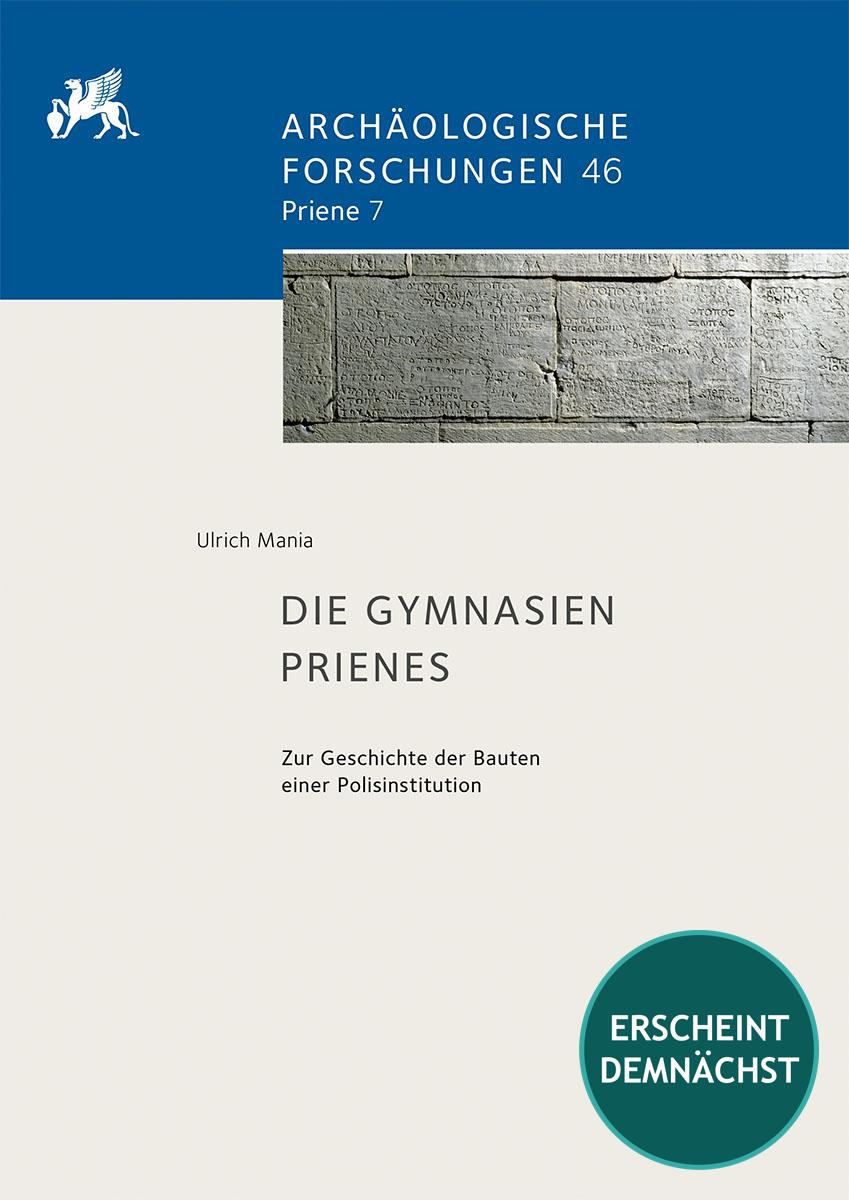
Field archaeological research in the two gymnasia of the Ionian city of Priene, together with inscriptional evidence, makes it possible to trace the history of the institution and its buildings as an exemplary case study. The investigations thus represent a contribution to research on the transformations of a central institution of the Greek polis in a time frame from the Late Classical to the Roman Imperial period. At the same time, the most recent excavations in the two building complexes and the associated architectural documentation are presented in detail.
The institution of the gymnasium was an integral part of the Greek poleis and the buildings of this facility shaped the image of ancient cities from the Late Classical period until the Roman imperial period. In the Ionian polis of Priene, several gymnasium buildings have been preserved, including two palestras, a stadium and a Roman bath. Together with the inscriptions, it is possible to trace the development of the institution and its structural facilities over almost half a millennium. Both the excavations of the late 19th and early 20th centuries and an archaeological field research project that took place between 2009 and 2012 contribute to this. In the course of the research, it emerged that the findings in Priene are particularly suitable for gaining a better understanding of the development of the gymnasium in Asia Minor: Thus, the earliest known Late Classical palestra in Asia Minor could be recognized in the structural remains of the Upper Gymnasion, while significant remains of a Hellenistic palestra have been preserved in the Lower Gymnasion because it was not built over by a bath like many other examples in Roman Asia Minor. In this way, general lines of development towards the Greek gymnasium become visible in a concrete example, such as the construction of a relatively small palestra and separated running tracks in the Late Classical period, the construction of a Hellenistic complex in which palestra and stadium form a structural unit, and the significant changes of the imperial period, when Roman bathing habits moved into the gymnasiums of Asia Minor and thus brought about far-reaching structural changes. This book will also present the most recent excavations and construction documentation in the two gymnasia of Priene together with partial reconstructions of their architecture.
After training as a stonemason, Ulrich Mania studied classical archaeology and history of art at the University of Halle, where he completed his doctorate with a thesis on the function and decoration of a Pergamenian sanctuary. After professional stations at the Universities of Kiel and Bonn, the author used a research stay at the University of Oxford to write a post-doctoral thesis on the development of gymnasia in Asia Minor between the Late Classical and Roman Imperial periods. Ulrich Mania was and is active in field archaeology and conservation in Priene and Pergamon. Since 2016, he has been working as a scientific referent at the German Archaeological Institute Istanbul.
In the series of “Archäologische Forschungen” (Archaeological Studies), monographs on the various areas of research in Classical Archaeology are published, mainly concentrating on studies concerning architecture, urban research, topography and everyday culture of Greece, Asia Minor, and the periphery of the Greek world. The chronological scope ranges from the beginning of periodized history to late antiquity. The following volumes, partly to be published in sub-series, will present the findings of research and excavations in the Hellenistic and Roman towns of Priene, Aizanoi and Pompeii. “Archäologische Forschungen” are edited by the Head Office of the Deutsches Archäologisches Institut (German Archaeological Institute) in Berlin.

 Sample
2.6 MB
Sample
2.6 MB