The book’s subject is a detailed presentation of plain ceramic from the early Islamic town Kharab Sayyar in the north-east of Syria, taking into account questions of merchandise, typology and chronology, as well as natural science. The insights thus gained aids the historical and cultural placement of the Islamic site Kharab Sayyar within both ist immediate and ist wider political and cultural context.
On this series:
The work of the German-Syrian excavation team in Kharab Sayyar focuses on the exploration of an extensive Islamic urban settlement from the 9th century AD, whose importance for the reconstruction of the town’s original appearance, especially of the artistic development (stucco decorations, mural paintings), became apparent even after the first excavation campaigns. This volume on Islamic ceramic introduces the series „Deutsch-Syrische Ausgrabungen im islamischen Kharab Sayyar“ (KHS); other volumes will focus on individual excavation sectors and on the findings. A manuscript for the publication on the so-called „Great House“ (sector E) by Michael Würz is already at hand, a study by Angela Koppel on the stucco decorations in the „Great House“ and the Mosque is under preparation. Publications of the findings around the Great Mosque (Imad Mussa, 2012), the Bath (Natascha Matyschok, 2013), and an evaluation of the examination of hydraulic engineering and watermanagement (Michael Würz, 2013) are intended to follow.
Compared to other archaeological disciplines, early Islamic archaeology is still a relatively new field of study, in which several gaps in research are yet to fill, particularly in the field of the study of ceramic, which is central to the cultural and chronological placement of an excavation site. The work at hand presents plain ceramic, not decorated with elaborate plastic decorations, painting or glaze, from the early Islamic site Kharab Sayyar in the north-east of Syria, which has been explored by the Goethe University Frankfurt am Main since 1997, and thus makes it available to the academic research community for the first time. Using a catalogue of goods based on macroscopic and product-related technical considerations as well as a comprehensive typological catalogue documented in drawings and photographs, comparisons to material from other early Islamic sites in Syria, Turkey, Iraq, Jordan and Lebanon are drawn, making it possilbe to place the early Islamic town Kharab Sayyar within its culture-historical and political context and the surrounding region possible. Furthermore, x-ray fluorescence and thin section analyses of samples of different ceramic goods revealed specific chemical and petrographic characteristics of the goods, which provide some insight into the production process and the raw materials used, as well as allowing scientifically substantiated definitions of the examined goods. All in all, the results of these studies constitute a major contribution to the study of early Islamic ceramic in the 8th to 10th centuries and of the cultural development of the Abbasid empire in the north-east of Syria, additionally demonstrating the importance of Kharab Sayyar as a main point of reference for archaeological and historical research on the early Islamic period.
„In dem vorliegenden Werk wird die unverzierte, d. h. nicht mit aufwendigem plastischen Dekor, Malerei oder Glasur versehene Gebrauchskeramik aus dem seit 1997 von der Goethe-Universität Frankfurt am Main erforschten frühislamischen Fundort Kharab Sayyar in Nordostsyrien präsentiert und so erstmals der wissenschaftlichen
Forschung zugänglich gemacht. (...) Die so gewonnenen Forschungsergebnisse leisten insgesamt einen wichtigen
Beitrag zur Forschung zur frühislamischen Keramik des 8. bis 10. Jahrhunderts und zur kulturgeschichtlichen Entwicklung des abbasidischen Reiches im Nordosten Syriens und belegen zudem die Bedeutung Kharab Sayyars als wichtiger Referenzort für archäologischhistorische Forschungen zur frühislamischen Zeit.“
In:
www.KunstbuchAnzeiger.de, März 2014.
Dr Christian Falb
Born 1966, studied Near Eastern Archaeology, Ancient Eastern Philology and Pre- and Early History at he Goethe University Frankfurt am Main from 1991 to 1999. Since his studies, he has taken part in numerous archaeological excavations in Germany, France, Oman and Syria. In 2006, he gained his doctorate with an interdisciplinary study on Early Bronze Age ceramic in Syria, which was awarded the Mediterran Prize of the Goethe University Frankfurt for outstanding publications. The main focus of his research is on the Early Bronze Age civilisations and ceramic remains in Syria and the adjacent south-east of Turkey, a field in which he has participated in several research projects and written various papers. At present, Christian Falb works as a research associate and lecturer at the Intitute for Archaeological Sciences of the University of Frankfurt am Main.
The work of the German-Syrian excavation team in Kharab Sayyar focuses on the exploration of an extensive Islamic urban settlement from the 9th century AD, whose importance for the reconstruction of the town’s original appearance, especially of the artistic development (stucco decorations, mural paintings), became apparent even after the first excavation campaigns. This volume on Islamic ceramic introduces the series „Deutsch-Syrische Ausgrabungen im islamischen Kharab Sayyar“ (KHS); other volumes will focus on individual excavation sectors and on the findings. A manuscript for the publication on the so-called „Great House“ (sector E) by Michael Würz is already at hand, a study by Angela Koppel on the stucco decorations in the „Great House“ and the Mosque is under preparation. Publications of the findings around the Great Mosque (Imad Mussa, 2012), the Bath (Natascha Matyschok, 2013), and an evaluation of the examination of hydraulic engineering and water management (Michael Würz, 2013) are intended to follow.
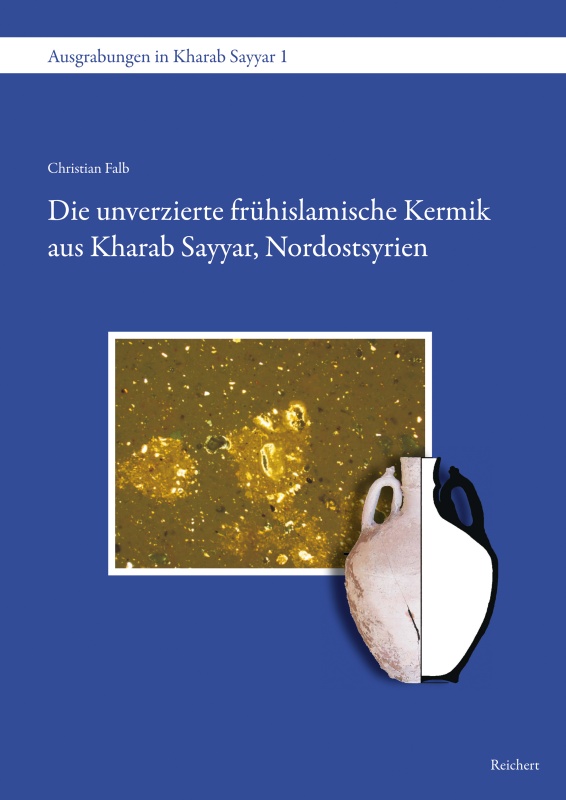
 Table of Contents