The following work serves as a thorough, typological investigation of the military equipment and horse harnesses found in the Vesuvian cities of Pompeii, Herculaneum, and Stabiae. The broad material basis of this research, and the fact that the original state of the findings can often still be reconstructed, serve to augment and expand upon the discoveries and interpretations that have been achieved in Rome’s northwestern border provinces. Additionally, the context of the Pompeian findings in particular makes it possible to draw conclusions about the significance of the military in a largely “demilitarized” Italian town.
The history of archaeological investigation in Pompeii, Herculaneum, and Stabiae now stretches back over 250 years. On the whole, this has been a history defined by sensational individual findings and monuments. However, with the exception of a few valuable items, little attention has been paid to military equipment and horse harnesses. One reason for this is the long disregard for everyday objects shown by archaeological research; additionally, the presence of the military among the largely “demilitarized” surroundings of the Vesuvian region had not been entirely clarified. At the same time, it is precisely the location of these cities on the “military periphery”, as well as the extraordinary preservation of the artifacts found there, that makes the Vesuvian cities so crucial for investigating and interpreting the civilian context of Roman military equipment.
The catalog and the main body of this work provide an extensive typological study of offensive, defensive, and ceremonial weaponry, as well as of horse harnesses and their individual components. The study has shown that the majority of objects found in Vesuvian cities, with few exceptions, conform to the known spectrum of forms found in the northwestern provinces. This conformity speaks to the high degree of standardization in the equipment of Rome’s imperial army. However, the objects also display significant local variations and particularities unique to the Vesuvian region.
Through its analysis of secondary sources and careful reconstruction of the original context where discoveries were made, and through its incorporation of a wide variety of epigraphic and other archaeological sources, this study produces a multifaceted and complex picture of the military presence in Vesuvian cities. It has long been assumed that soldiers were compelled to hand in all of their equipment before their honesta missio; if this is the case, the findings can only be explained by the presence of active soldiers. The evidence, however, argues for a different perspective: it suggests that certain veterans retained some of their equipment (above all, their swords) after quitting the active service, employing it in a “paramilitary” or private capacity – for example as craftsmen, tradesmen, city police, domestic security, or bodyguards – or holding onto it as a memento. The contexts in which the largely intact sets of horse harnesses have been discovered, on the other hand, are unambiguously civilian in nature, and demonstrate that it is nearly impossible to make typological distinctions between horse harnesses of a civilian and military nature in early imperial times.
The broad material basis of this research, and the fact that the original state of the findings can often still be reconstructed, serve to augment and expand upon the discoveries and interpretations that have been achieved in Rome’s border provinces. The study not only sheds light on the relationship between veterans and the local populace – and the relationship between soldiers and the travelling Praetorian Guard – but also answers the question of whether weapons and horse harnesses belonged to the standard inventory of upper-class households in the Vesuvian region.
„This book offers a detailed and and well thought out analysis of the surviving Roman military material and horse equipment from the area around Mt. Vesuvius and enables the reader to understand how the finds from this unique archaeological landscape compare to those of the wider Roman world [...] [I]t can certainly be said, that Ortisi has produced a compelling and detailed analysis of military finds from Pompeii, Herculaneum, Stabiae and Boscoreale, allowing the reader to compare the relevant archaeological record of these cities with other parts of the Roman Empire. [...] [T]he vast number of finds and the excellent preservation of these cities as a whole, allows scholars to advance their understanding of Roman urbanism, including the origin and use of military equipment in such settings.“
Von: Sebastian Schuckelt
In: Journal of Roman Studies, Band 107, S. 394-395; DOI: 10.1017/S0075435817000272.
--------------------------------
„Die Studie liefert nicht nur Erkenntnisse über die Beziehung zwischen der lokalen Bevölkerung und den Veteranen sowie den durchreisenden Prätorianern und Soldaten, sondern gibt auch Antworten auf die Frage, ob die Waffen und das Pferdegeschirr zur standardisierten Ausstattung gehobener Wohnhäuser in den Vesuvstädten gehörten.“
In:
www.fachbuchkritik.de--------------------------------
„Salvatore Ortisi’s book can be recommended not only to researchers of Roman weaponry, but also to historicans dealing with the social history of Campania. And more broadly, those interested in the social history of Rome. The phenomena described in the book can be treated as a noteworthy illustration of similar social and cultural situations that no doubt also occurred in other regions of its empire.“
Von: Edward Dabrowa
In: Latomus 76/2, Juni 2017
Prof. Dr. Salvatore Ortisi completed his studies of Provincial Roman Archaeology, Prehistory and Early History, and Ancient Civilization in Munich and Cardiff. In 1998, he was appointed to the Department of Provincial Roman Archaeology at the Ludwig Maximilians University of Munich, with the research topic “City Walls in the Raetian Provincial Capital of Aelia Augusta – Augsburg”. In 2009, the present work was submitted as his habilitation to the Department of Archaeology of the Roman Provinces at the University of Cologne, where he was made Senior Researcher the same year. Since 2015, he has been a Professor of Archaeology of the Roman Provinces at the University of Osnabrück.
With PALILIA, the German Archaeological Institute of Rome introduces a new series of publications, primarily monographs on archaeological research done in or starting from Italy. The series will deal with new approaches and innovative research methods, and subjects neglected in classical archaeology. The subject range includes central archaeological research areas, such as Graeco-Roman sculpture, iconography, architecture, urban research, and topographic studies, as well as topics from social and economic history, history of religion and of everyday life.

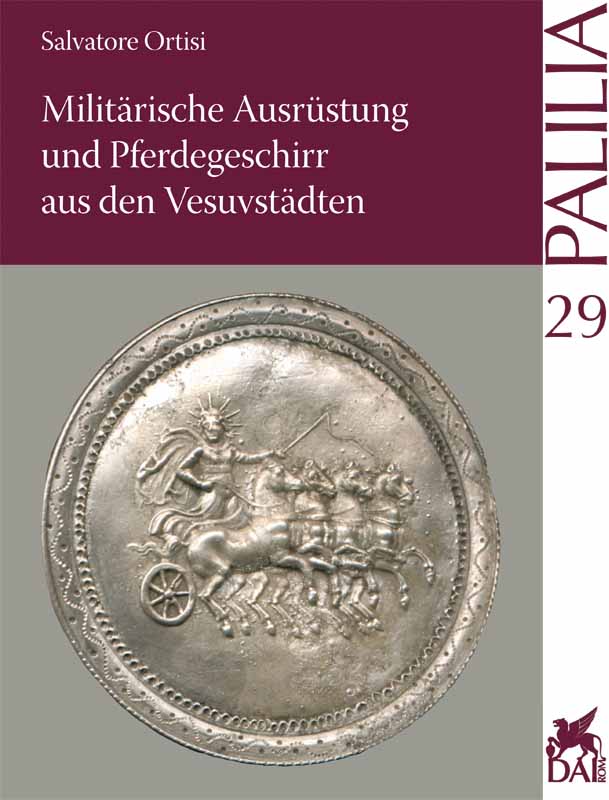
 Table of Contents