The Hippodrome is one of the largest garden facilities in the Imperial Palace on the Palatine Hill in Rome. This monograph provides the first comprehensive analysis of its architectural ornamentation. On this foundation, the structure’s decorative systems are reconstructed. By analyzing the Hippodrome’s architectural decoration and assessing its place within the palace facility itself – as well as within the broader context of garden and villa architecture of the imperial period – we reach a new understanding of the structure, and how it was integrated into Rome’s Imperial Palace. This work contributes to the study of the architectural decoration of the city of Rome while simultaneously closing a gap in the study of the Imperial Palace as a whole.
For centuries, the Imperial Palace on the Palatine Hill in Rome served as the seat of the Roman emperors. Significant portions of the palace have survived, but mostly in the form of opus caementicium walls, devoid of the original architectural decoration. Despite its enormous significance to architectural history and its socio-political importance, the palace has only become an object of systematic scientific study within the past 20 years.
This monograph focuses on an important feature of the palace: the Hippodrome garden and its architectural decoration. The monograph sheds light on central aspects of Roman architectural history in two respects: By presenting the architectural decoration of the Hippodrome garden as a body and by subjecting it to comprehensive analysis for the first time, this work contributes to the study of architectural decoration in the city of Rome. At the same time, the work closes a gap in the study of the Imperial Palace.
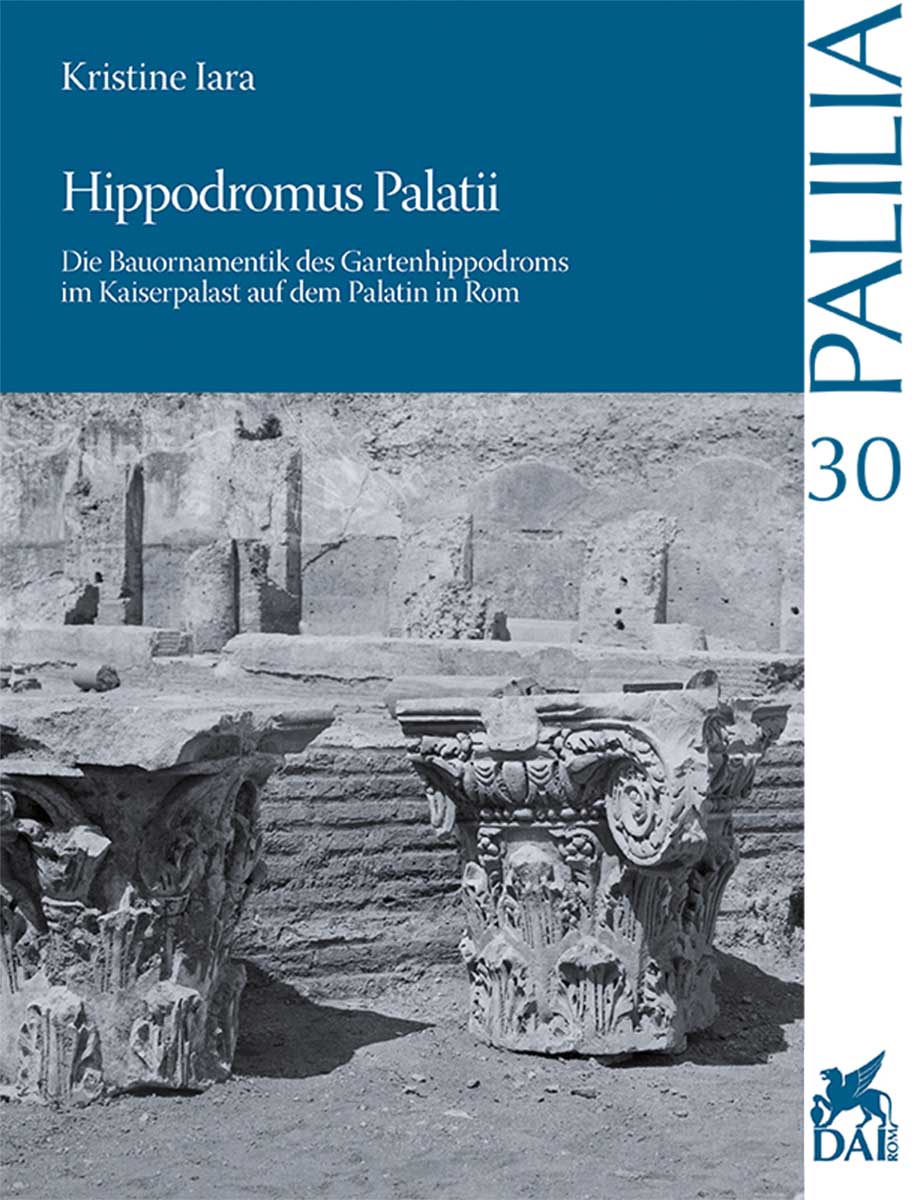
The Hippodrome, built chiefly during the Flavian and Severan eras, is one of the largest garden facilities in the palace. Part of it has survived in the form of masonry walls; part in the form of approximately 900 fragmented marble components. In the first section of this work, these components and their ornamentation are catalogued and analyzed for the first time. The architectural decoration of the Hippodrome is reconstructed on this foundation.
The second section is dedicated to an overall assessment of the decoration, and of the structure itself. Typologically, the structure belongs among the hippodromi, a distinct kind of Roman garden found in villa architecture. By analyzing its architectural decoration and assessing its place within the palace facility as a whole – as well as within the broader context of garden and villa architecture during the imperial period – we reach a new understanding of the structure and how it was integrated into Rome’s Imperial Palace.
The Hippodrome garden on the Palatine is an exceptional example of this building type, representing an elevated, refined version of a form adapted from the architecture of aristocratic villas. Integrating a known form into the Imperial Palace – a form already established in villa architecture – was intended to make the greatest possible impact while also finding acceptance among the populace. The general popular recognition of the building type at once warded off the impression of extravagance, while simultaneously implying the magnificence of such a facility through its association with the word hippodromus, alluding thereby to the magnificence of its contractor, the emperor. Thus, considering its design, its decoration features, and the connotations tied to these, the construction of a hippodrome garden in the Imperial Palace in Rome signified imperial standing of the highest order.
„Die Erforschung der ausgedehnten Palastanlagen auf dem Palatin hat in den letzten zwanzig Jahren in vielerlei Hinsicht zu einer neuen Bewertung kaiserlicher Repräsentationsarchitektur geführt. Kristine Iaras grundlegende Studie zur Baudekoration des sogenannten Gartenhippodroms schließt hier sowohl in inhaltlicher als auch methodischer Hinsicht auf höchstem Niveau an. [...]
Im Vorwort zu einer früheren Arbeit habe ich die mit Absicht überspitzte Sorge geäußert, dass die „lange und weithin anerkannte Tradition“ der Bauornamentikforschung innerhalb der Klassischen Archäologie immer auch die Gefahr berge, „dass die Objekte der Forschung aufgrund von Konventionen oder purer Selbstverständlichkeit als Mittel zum tradierten Selbstzweck missverstanden werden“, eine Haltung, die sich vor allem daran zeige, dass es „scheinbar keine neuen Fragen in Bezug auf Bauornamentik mehr zu stellen gibt.“ (1)
Kristine Iaras Buch darf als gelungenes Beispiel dafür gelten, wie man einen solchen Stillstand auf Basis einer stringenten und konsequent durchgehaltenen Methodik nicht nur vermeiden, sondern dabei auch eine ganze Reihe lohnender Fragestellungen für die Forschung erschließen kann. Dank ihrer Leistung haben wir mit dem Hippodrom des Palastes auf dem Palatin einen wichtigen neuen Referenzpunkt für die Baugeschichte der römischen Kaiserzeit gewonnen.“
Von: Dr. Dominik Maschek (University of Birmingham)
In: Göttinger Forum für Altertumswissenschaften 20 (2017), 1139-1145.
(1) D. Maschek, Rezension zu M. Tombrägel, Die republikanischen Otiumvillen von Tivoli, Palia 25 (Wiesbaden 2011), Göttinger Forum für Altertumswissenschaften 16, 2013, 1129-1145; http:/ / gfa.gbv.de / dr,gfa,016,2013,r,20.pdf.
Dr. Kristine Iara studied Classical Archaeology, Latin and Ancient Greek, and Ancient History at the University of Cologne, where she received her doctorate in 2007 following completion of the present work. From 2003–2008, she was employed at the German Archaeological Institute (DAI), Rome Department. She received a postdoctoral research grant from the German Archaeological Institute in Rome from 2009–2012, for a project on the sacral topography of pagan cults in late antique Rome (academic affiliation: Ludwig-Maximilians-Universität of Munich). Since 2014, she has served as Collection Development Librarian for Classical Studies at the American Academy in Rome. Her research focuses on the archaeology and the topography of the city of Rome, the imperial period, Rome in late antiquity.
With PALILIA, the German Archaeological Institute of Rome introduces a new series of publications, primarily monographs on archaeological research done in or starting from Italy. The series will deal with new approaches and innovative research methods, and subjects neglected in classical archaeology. The subject range includes central archaeological research areas, such as Graeco-Roman sculpture, iconography, architecture, urban research, and topographic studies, as well as topics from social and economic history, history of religion and of everyday life.

 Preface