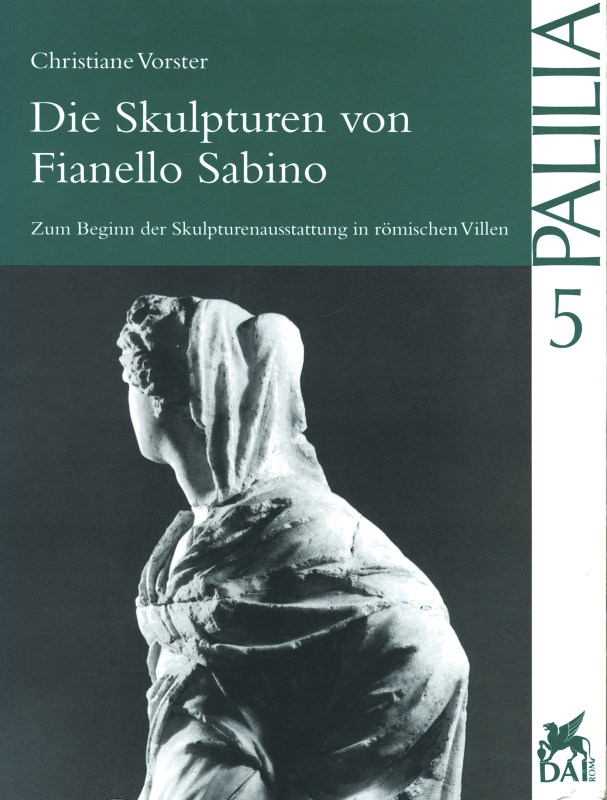
Marble sculptures are an essential part of the furnishings of Roman villas and gardens. The complex of findings of sculptures from the villa of Fianello Sabino in the northern part of Latium in the form of new photographs represents the most complete and, until now, oldest known example of the furnishings of a late republican villa dating back to the time around 100 BC. Almost all subject areas characteristic of the leisurely life in villas are already represented in this work: Dionysian dancers, boyish athletes and portraits of well-known Greeks, small idols, and even large-formatted portrait statues and exquisite marble devices.
An analysis of the monuments according to criteria with regard to their contents and style as well as the technical aspects allows precise statements to be made on the origin, acquisition and presentation duration of the sculptures. They were probably made in Delos and were largely acquired as an ensemble. The late Hellenistic furnishings of the villa did not lose in value during the course of the Caesar period, on the contrary, fulfilled their purpose as precious ornaments of a stately country residence up until the late Graeco-Roman times.
„Signalons que cet ouvrage, publié dans la trè belle série des Palilia éditée par l’Institut Archéologique Allemand de Rome, est édité à un prix qui permet à toute bibliothèque archéologique de se le procurer. On en peut que s’en réjouir.“
In: Latomus. LXIII (2004) Nr. 1053.
------------------------------------------
„Although a small corpus, the Fianello statues broaden our picture of Hellenistic sculpture in Italy beyond Rome and Magna Graecia. Vorster believes that Hellenistic ideal statues survive an Italian soil in numbers comparable to chose from the early Imperial period, but that they go unrecognized; an historical grounds, this seems debatable. If indeed there are previously unrecognized Hellenistic pieces lurking in museum storerooms, however, Vorster's thorough catalogue descriptions and excellent photographs show us in general terms what we should be looking for.“
In: American Journal of American Archaeology. 104 (2000). S. 144-145.
------------------------------------------
„Le volume est complété par un bon résumé Italien et illustré par un double jeu de photographies, les unes à l’effet plus recherché (Gabinetto Fotografico Naziovale) faisant ressortir la réelle qualité artistique des oeuvres, les autres (DAI, Rome), plus techniques ou plus «objectives», fournissant le dossier aujourd'hui habituel en la matière (face, dos, profils, trois-quarts et détails); heureuse innovation, que l'on saluera comme il se doit.“
In: L’Antiqute calssique. LXIX (2000). S. 553-554.
With PALILIA, the German Archaeological Institute of Rome introduces a new series of publications, primarily monographs on archaeological research done in or starting from Italy. The series will deal with new approaches and innovative research methods, and subjects neglected in classical archaeology. The subject range includes central archaeological research areas, such as Graeco-Roman sculpture, iconography, architecture, urban research, and topographic studies, as well as topics from social and economic history, history of religion and of everyday life.