The book contains 21 contributions to a colloquium held in March 2006 in honour of W. Sundermann and dealing with various aspects of the literatures in the Middle Iranian languages. Texts and motifs and their origins and developments in Middle Persian, Parthian, Saka and Sogdian texts and in the unique Manichaean Bactrian fragment are discussed and presented together with a depiction of Avestan, Aramaic, Mandaic and even Celtic motifs.
This volume contains edited versions of the contributions to a colloquium held at the Berlin Brandenburg Academy of Sciences and Humanities on the 30th and 31st of March 2006 with the title: ‘Literary materials and their form in the Middle Iranian period. Colloquium in honour of the 70th birthday of Prof. Dr. Werner Sundermann’. The colloquium was dedicated to a topic localised in the Sasanian Empire and on the Silk Road and concentrating on the first millennium CE. The contributions deal in particular with the re-occurrence of individual motifs and concepts in the various strands of the literatures in the Middle Iranian languages. Besides selected aspects of the tradition of the Avesta, of learned women in Middle Persian legal discourse, of the Alexander novel in Pahlavi literature, and of Buddhist texts such as the Saka ‘Book of Zambasta’ and the Sogdian Vessantarajataka the main focus is on the dispersal of narrative works by the Manichaeans through Middle Iranian into Old Turkish literature und even as far as China. Complementing this are contributions on the Aramaic and Mandaic traditions and the first comprehensive edition of the much discussed Manichaean Bactrian fragment. A possible Iranian-Celtic literary influence is also discussed.
The contributions are in English (11), German (9) and French (1).
(01) Peter Zieme: Laudatio
(02) François de Blois: On the sources of the Barlaam Romance or: How the Buddha became a Christian saint
(03) Iris Colditz: „Autorthema“, Selbstproklamation und Ich-Form in der alt- und mitteliranischen Literatur
(04) Desmond Durkin-Meisterernst: The literary form of the Vessantatarajataka in Sogdian
(05) Philippe Gignoux: Les relations interlinguistiques de quelques termes de la pharmacopée antique
(06) Almuth Hintze: The Return of the Fravashis in the Avestan Calendar
(07) Manfred Hutter: Das so genannte Pandnamag i Zardušt: Eine zoroastrische Auseinandersetzung mit gnostisch-manichäischem Traditionsgut?
(08) Maria Macuch: Gelehrte Frauen – ein ungewöhnliches Motiv in der Pahlavi-Literatur
(09) Mauro Maggi: Annotations on the Book of Zambasta, I
(10) Enrico Morano: Sogdian Tales in Manichaean Script
(11) Antonio Panaino: Ahreman and Narcissus
(12) Christiane Reck: Soghdische manichäische Parabeln in soghdischer Schrift mit zwei Beispielen: Parabeln mit Hasen
(13) Kurt Rudolph: Literarische Formen der mandäischen Überlieferung
(14) Shaul Shaked: Spells and incantations between Iranian and Aramaic
(15) Nicholas Sims-Williams: The Bactrian fragment in Manichaean script (M 1224)
(16) P. O. Skjærvø: Reflexes of Iranian oral traditions in Manichean literature
(17) Alois van Tongerloo: A Nobleman in Trouble or the consequences of drunkenness
(18) Dieter Weber: Ein Pahlavi-Fragment des Alexanderromans aus Ägypten?
(19) Jens Wilkens: Ein manichäischer Alptraum?
(20) Yutaka Yoshida: Karabalgasun Inscription and the Khotanese documents
(21) Stefan Zimmer: Vom Kaukasus bis Irland — iranisch-keltische Literaturbeziehungen?
“To sum up, the volume under review is a very important contribution on the literary histories of the Ancient and Medieval epochs, Iranian linguistics, Central Asian history and various related items.”
P. B. Lurje
in: Orientalistische Literaturzeitung. 105 (2010) 6. Sp. 778-784.
Dr. Desmond Durkin-Meisterernst, is head of the long-term project ‘Turfan Studies’ (‘Turfanforschung’) at the Berlin Brandenburg Academy of Sciences and Humanities and edits the Middle Iranian fragments of the Turfan Collection, Berlin.
Dr. Christiane Reck, works for the Union Catalogue of Oriental Manuscripts in German Collections cataloguing the Sogdian fragments of the Turfan Collection.
Dr. Dieter Weber, works at the Institute of Iranian Studies in the Free University Berlin and is, among other things, an expert in deciphering the Middle Persian letters and administrative documents of the late Sasanian period.
The series Beiträge zur Iranistik was founded in the 1960s by Georges Redard and subsequently edited by Nicholas Sims-Williams from 1997 to 2020; the present series editor is Agnes Korn.
The series publishes works on the languages of the Iranian branch of Indo-European. The focus is on linguistics, including grammars, dictionaries, text editions, philology as well as diachronic and synchronic studies of linguistic topics. Neighbouring fields such as literature, archaeology and anthropology are likewise represented. The languages of the series are English, German and French. The Beiträge zur Iranistik are represented in libraries internationally and are widely used standard works of Iranian studies.
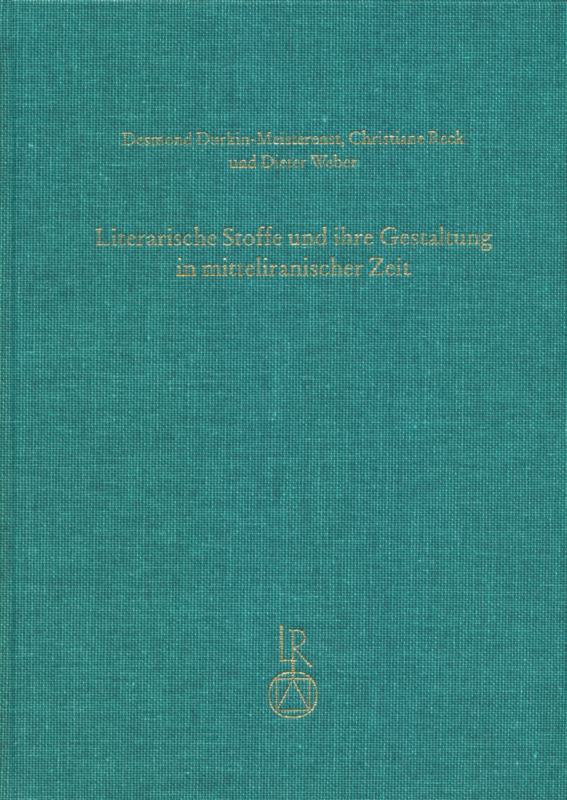
 Table of Contents