On November 6, 1823, four Englishmen disembarked in the harbour of Alexandria. In the succeeding ten months, they traveled up the Nile as far as the Second Cataract and, in the course of their travels, witnessed the turmoils of a revolution against Mohamed Ali Pasha, the viceroy of Egypt. In this volume, Henry Westcar’s journal, which was written during this journey, is edited and annotated for the first time in its entirety. Additionally, the book offers a profound overview of the reign of Mohamed Ali Pasha and particularly the treatment of ancient monuments. The topic of the famous “Westcar Papyrus”, which owes its name to the author of the journal, is discussed in an excursus.
On this series:
“Menschen - Reisen - Forschungen. Wissenschaftsgeschichte aus Ägypten” is a new series published by the German Archaeological Institute in Cairo. It comprises biographical works about individual researchers and travellers in Egypt, especially in the nineteenth and early twentieth centuries. The extensive material from the archives of the Institute in Cairo is thereby made available to a growing readership with an interest in the scientific history of oriental countries. Each volume in this series is scientifically sound, extensively illustrated and written in an accessible style.
Volumes on the Egyptologists Heinrich Brugsch (1827-1894), Heinrich Schäfer (1868-1957), and Ludwig Keimer (1892-1957), the architect and geodesist Georg Gustav Erbkam (1811-1876), the Africanist and botanist Georg Schweinfurth (1836-1925), the ophthalmologist, orientalist and Arabist Max Meyerhof (1874-1945) and on the history of the Deutsches Haus in Thebes (1904-1966) are in preparation.
In November 1823 a young English gentleman, by the name of Henry Westcar, landed in Alexandria to discover the glory of ancient Egypt. He was neither an archaeologist, nor of famous stock, but only one more member of the English gentry taking the Grand Tour. His name might have easily fallen into oblivion, would it not have been connected to one of the most famous ancient Egyptian literary papyri: the papyrus Westcar. Most probably it was acquired by him on occasion of his trip up the Nile as far as the second cataract and back. But Westcar’s voyage is remarkable not only for the probable purchase of the famous papyrus. In Egypt he became eyewitness of a revolution against the ruling pasha. His diary is one of the main sources to supply information about the rebellion that rose in Upper Egypt, as well as the means taken by the pasha and his army to quell it. Westcar and his three fellow travellers, all of them promising young architects, suddenly found their trip, which was started to explore the temples and tombs of the pharaohs, change into a flight downriver to escape the rebellion.
For the first time the entire travelogue of Henry Westcar is published, together with an overview of the reign of Muhammad Ali Pasha as well as an appendix in which the ownership of the papyrus Westcar is discussed. The text is elaborately illustrated not only with photos but also with sketches and drawings, the latter ones whenever possible executed by Westcar’s companions or artists travelling in the same period of time. Almost 200 years after Henry Westcar has returned from his trip to the Nile, his diary is finally published.
„The book is definitely well worth reading, at least for Westcar's diary with its commentary. The editor, however, fails to provide more information on Westcar himself before and after his travel on the Nile. Despite the mistakes mercilessly highlighted in this review, the edition of the diary is quite accurate, the commentary is generally informative and most of the notes provide helpful information. On the other hand, the general part on Mehmet 'Ali's reign is disappointing and so too the reconstruction of the "War of the Consuls" period and the discussion of heritage-related issues. To add more to the current knowledge of the period, a thorough discussion of the 1824 uprising would have been welcomed. The set of illustrations is really impressive and enriches the volume.“
Von: Daniele Salvoldi
In: Journal of the Society for the Study of Egyptian Antiquities, Jessa 38 (2011-2012), S. 250-258.
Heike C. Schmidt has studied Egyptology at Mainz University. She has lived for several years in Egypt and is working as a journalist. Her main interest lies in the history of science of Egypt.
“Menschen - Reisen - Forschungen. Wissenschaftsgeschichte aus Ägypten” is a new series published by the German Archaeological Institute in Cairo. It comprises biographical works about individual researchers and travellers in Egypt, especially in the nineteenth and early twentieth centuries. The extensive material from the archives of the Institute in Cairo is thereby made available to a growing readership with an interest in the scientific history of oriental countries. Each volume in this series is scientifically sound, extensively illustrated and written in an accessible style.

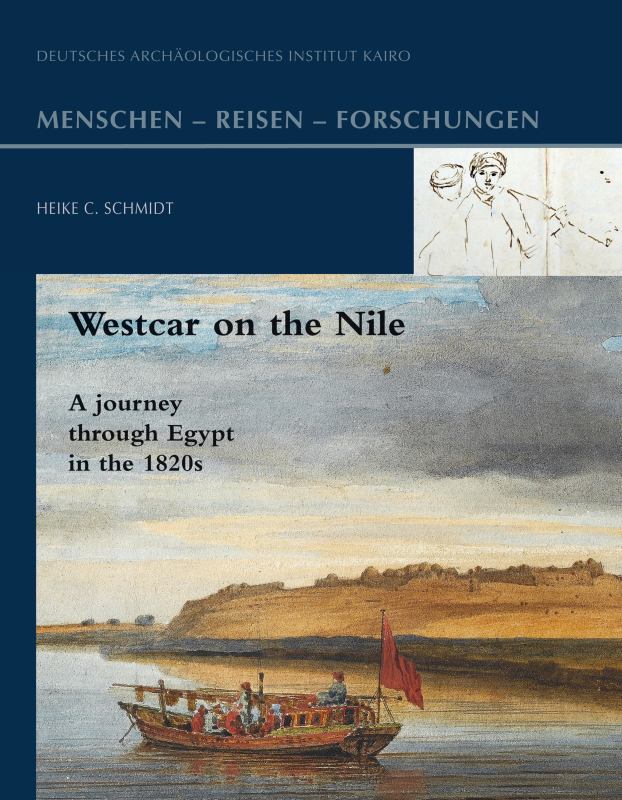
 Table of Contents