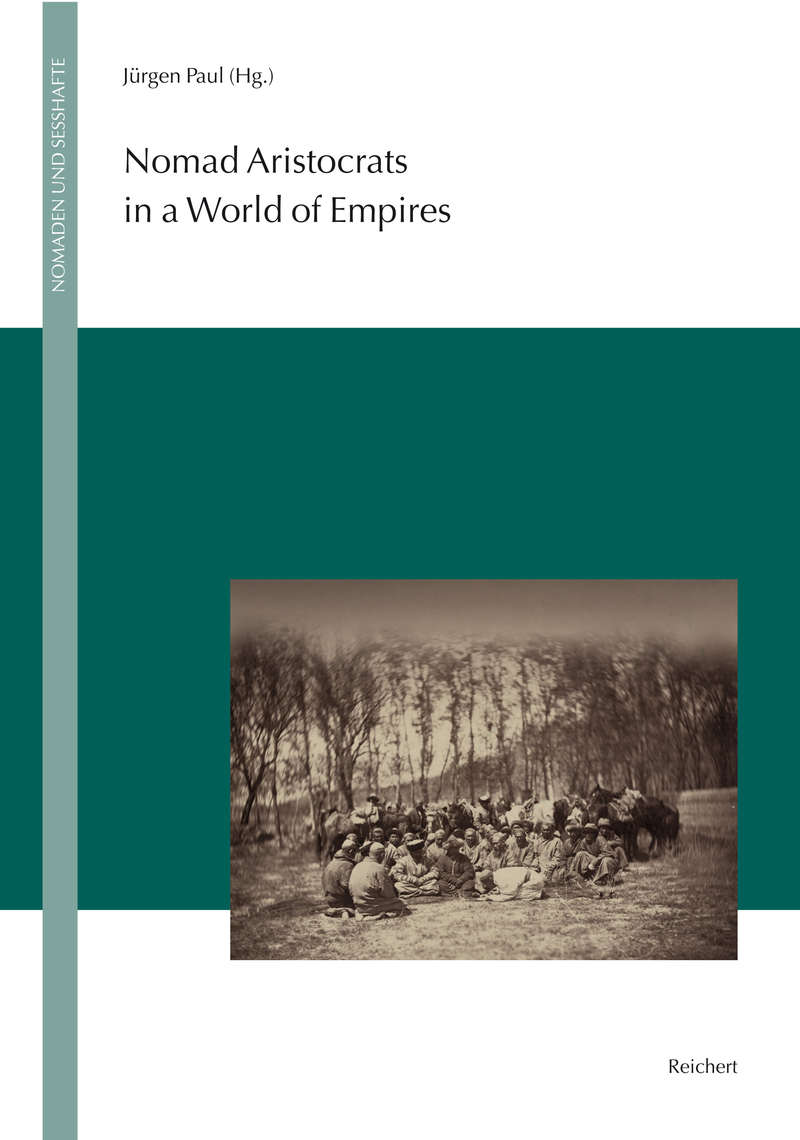
The papers published in this volume go back to a conference held November 2011 in Hamburg. The conference was built around the question of domination: of nomads over sedentary people, of sedentary people over nomads, and of nomads over nomads. The contributions study how domination worked in a nomadic context, and how nomadic elites (aristocracies) related to imperial rule.
The papers in the present volume go back to a conference held November 2011 in Hamburg. This conference was built around a central subject, domination, in the interaction between nomadic and sedentary groups and policies, but it also considered internal hierarchies within the nomadic groups. The contributions published here concentrate on Inner Eurasia and the Turko-Iranian world, the Xiongnu, the Seljuqs, and the early Ottomans until ca. 1500 CE. Some contributions take a more general stance and discuss subjects such as “tribalism” in a theoretical framework; one contribution is on the place of the Eurasian steppe nomads in world military history.
One of the central issues is the uneasy relationship between a royal or imperial ruler or dynasty and a stratum of local lords or leaders; in many cases, these local (“aristocratic”) leaders do not owe the power they wielded to some delegation or appointment from “above”. Another question in this context is the problem of fission – how an empire may fall apart along fault lines that may be perceptible even when the empire is strong.
Another major probem is the old question of “tribalism”. What is the idiom of domination in the field? Is it kinship, and might the way in which some of the nomads studied here organise themselves therefore be called “tribalism”? Even though there is no single and consensual answer to this question in the present volume, a number of papers adduce new evidence which supports a negative answer.
„Cet ouvrage rassemble donc des contributions variées, autant dans leur champs d’analyse que dans leur méthodologie. La focalisation de la majorité des contributions sur l’espace eurasiatique participe toutefois à sa cohérence. Ce livre a le mérite de renouveler un domain d’étude certes déjà largement traité par les spécialistes de multiples disciplines (archéologues, historiens, anthropologues), mais abordé ici à travers une thématique - l’aristocratie nomade - stimulante, qui invite les chercheur à interroger voire remettre en question les concepts utilisés depuis plusieurs déciennes à propos du nomadisme et du pastoralisme.“
Von: Camille Rhoné
In: Bulletin critique des Annales Islamogique 30 (2014), S. 71-73.
Jürgen Paul, born 1949. PhD in Hamburg 1989 (title of thesis see German version). Habilitation in Hamburg 1993 (title see German version). 1995-2013 professor of Islamic Studies in Halle. Centre of research activities: Social history and history of domination in Iran and (Muslim) Central Asia, ca. 11th-16th centuries.
Hg. im Auftrag des SFB von Jörg Gertel, Stefan Leder,
Jürgen Paul und Bernhard Streck
Nomadische und sesshafte Lebensformen koexistieren in weiten Teilen der Welt, insbesondere im altweltlichen Trockengürtel, seit mehreren tausend Jahren. Die Erforschung ihrer Interaktion soll in der Reihe Nomaden und Sesshafte dokumentiert werden. Erst seit vergleichsweise wenigen Jahren hat die Einsicht an Geltung gewonnen, dass Nomadismus als Teil übergreifender ökologischer, ökonomischer, politischer und kultureller Systeme in den Blick genommen zu werden verdient, weil Formen des Kontakts mit der Welt der Sesshaften historische Zivilisationen über lange Zeiträume mitgeprägt haben und noch heute, unter anderen Bedingungen, Wirkung entfalten. Austausch und Konflikt zwischen Nomaden und Sesshaften, wie auch Prozesse der Anpassung und Abgrenzung haben sich auf unterschiedliche Lebensbereiche ausgewirkt. Ökonomie und Militärwesen, politische und soziale Ordnungen, Sprache und in Kunst, Vorstellungswelten und Identitätskonstruktionen geben dies zu erkennen. Mit der Wahrnehmung der Vielfalt und Wirkmächtigkeit dieser Interaktion ist eine Forschungsperspektive angelegt, welche die Aufgaben des 2001 einrichteten Sonderforschungsbereichs "Differenz und Integration – Wechselwirkung zwischen nomadischen und sesshaften Lebensformen in Zivilisationen der Alten Welt" bestimmt.
Der interdisziplinäre Rahmen des Sonderforschungsbereichs erlaubt die Beteiligung mehrerer Disziplinen, wie Archäologie und Geschichte, Literaturwissenschaft und Ethnologie, Geographie und Agrarökonomie; ihr Zusammenwirken verspricht Erträge, die eine Vielzahl von Perspektiven und Wissensbereichen erschließen.

 Preface