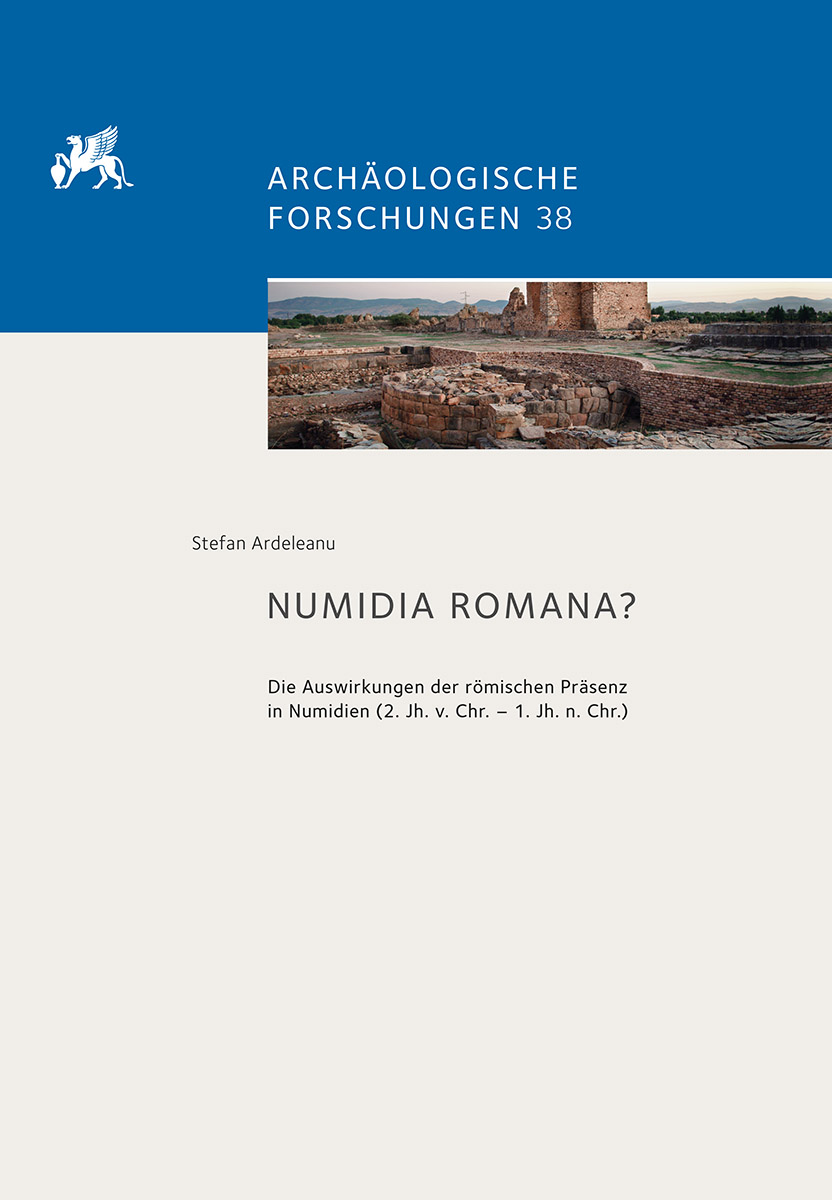
This volume presents for the first time a systematic study of the urban developments of pre-and early Roman Numidia. The author discusses both recent and older data from surveys and excavations. By means of autopsy, own fieldwork and the presentation of new diachronic city plans, the astonishingly early complexity of Numidia’s cityscapes is visualized. Houses, workshops, sanctuaries, funerary habits and economic developments are analyzed according to their continuities, ruptures and innovations. Through the focus on microregional/local evidence and by breaking with the accepted bipolar acculturation models, a fundamental reevaluation of North Africa’s so-called dark age and the identity discourses of that period is called for.
The complex phenomena surrounding the incorporation of Numidia into Rome’s sphere of control has been discussed to date predominantly on the basis of bipolar models such as Punicization, Romanization, resistance theory or autochthonology. As an alternative this study, which draws on the author’s own field research and is illustrated by six microregions, delineates the panorama of an extraordinarily early development of urban centers in Numidia, visualizing it with new diachronic phase plans. Referring to selected dwelling and workshop areas, sanctuaries and burial practice, the study identifies specific local and regional characteristics, some of which persisted into the imperial period. At the same time novelties appeared in cultic, mortuary, ceramic and architectural forms which cannot be explained either by the resistance of local groups or by the arrival of new groups, for instance Roman citizens. The complex ornamental and formal vocabulary of buildings and objects in addition to certain evidence of economy (marble imports and exports, ceramic imitations, coin distribution) prove that the towns of Numidia were perfectly integrated in Mediterranean trade networks and cultural transfer processes from the 2nd century B.C. onward. Close ties existed in particular with central Italy and led to mutual influence on politics and territory long before Numidia’s annexation (46 B.C.). Heterogeneous find contexts, distribution mechanisms and inscriptions show however that considerably more actors were involved in this exchange than – as assumed thus far – just the kings of Numidia and the Republican commanders and later the emperors. The common presumption of North Africa’s so-called dark age is thus confronted with a wealth of new excavation and survey data as well as a re-evaluation of recent and older research results. New explanatory models are thereby presented for this decisive phase in North Africa’s urban development and for the identity discourses of that period.
„The book could be seen as merely a bundle of congress papers, but it has more to offer: it shows an appealing power to think off the beaten track of research and offers a multitude of new insights that can stimulate further research. It is therefore a must-have for those who are engaged in the study of the Roman house.“
Von Richard de Kind
In: BABESCH 97 (2022), S. 255-256, doi: 10.2143/BAB.97.0.3290542
-----------------------------------------------------------------------------------------------------------------------------------------------
„Even before one has read any of the contents, one will be suitably impressed by this monograph: a hardcover folio-sized volume weighing a hefty three kilograms, almost 600 double-column pages on glossy paper, with 4430 footnotes, and many illustrations and maps. (...) This is an incredibly wide-ranging book, considering it is a monograph with single authorship. But as already stated: though wide-ranging it is not a general history of Numidia or a general guide to the many Roman remains, it has a purpose, namely to say something about cultural change and its driving forces. This is a study that is obviously of importance to anybody interested in the development of Numidia (or all of Northern Africa, or the whole circum-Mediterranean) between Hellenistic and early imperial days. But it is also an impressiv contribution to the study of the mechanisms and modalities of culture contact and culture change.“
By Frederick G. Naerebout
In: BABESCH 97 (2022), S. 242-244, doi: 10.2143/BAB.97.0.3290542
-----------------------------------------------------------------------------------------------------------------------------------------------
„[...] in showing what is possible when moving beyond those problematic colonial conceptual categories that have shaped interpretations of archaeological finds across Numidia, Ardeleanu offers one of the first truly postcolonial paths forward for North African studies. One can only hope that this monumental work will begin to shift the discourse for all who work in the region and serve as a model starting point for subsequent material histories of Rome’s African provinces.“
Von Matthew M. McCarty
In: American Journal of Archeology, Vol. 127, Nr. 1, 2023
------------------------------------------------------------------------------------------------------------------------------
„[...] this is the most important contribution to Numidian studies for decades, and it will frame all future discussion.“
Von Josephine Crawley Quinn
In: Journal of Roman Archaeology, Vol. 115, Nr 1-2, 2025
Stefan Ardeleanu studied Classical Archaeology, Ancient History and Byzantine Archaeology from 2006 to 2010 in Heidelberg, Rome and Aix-en-Provence before completing his PhD in 2015 at the Humboldt University in Berlin on pre- and early Roman Numidia. In 2016/17 he was awarded the ‘Reisestipendium’ of the German Archaeological Institute. Since 2015 he has worked on a post-doctoral project on Late Antique epitaphs and funerary contexts at the SFB 933 ‘Materiale Textkulturen’ in Heidelberg. His main research focuses are: North Africa (Hellenistic times until Late Antiquity), Roman funerary reliefs, Late Antique burial customs and the perception of antiquity in modern politics and culture.
In the series of “Archäologische Forschungen” (Archaeological Studies), monographs on the various areas of research in Classical Archaeology are published, mainly concentrating on studies concerning architecture, urban research, topography and everyday culture of Greece, Asia Minor, and the periphery of the Greek world. The chronological scope ranges from the beginning of periodized history to late antiquity. The following volumes, partly to be published in sub-series, will present the findings of research and excavations in the Hellenistic and Roman towns of Priene, Aizanoi and Pompeii. “Archäologische Forschungen” are edited by the Head Office of the Deutsches Archäologisches Institut (German Archaeological Institute) in Berlin.

 Sample