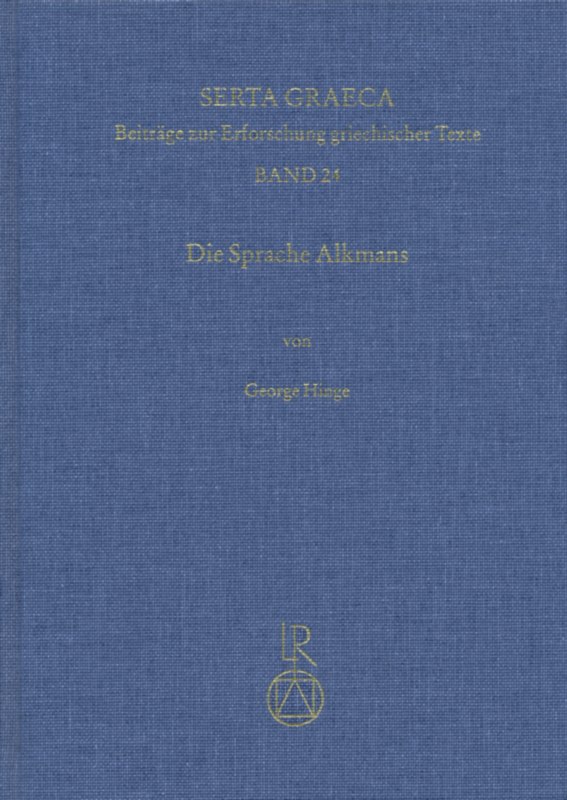
The Spartan poet Alcman is crucial to our understanding of the early history of the Greek dialects and the development of the Greek poetical language. He is not only the earliest choral lyric poet to have his fragments surviving to an appreciable extent, but also the only poet to use the Laconian dialect. Until now, a comprehensive treatment of the idiom of Alcman did not exist. The present book fills this gap, addressing itself to Classicists and Indo-Europeanists alike. The work is at the same time a phonology and morphology of the dialect of Alcman and a historical investigation of the formation of the poetical language and the transmission of the text.
The Spartan poet Alcman is crucial to our understanding of the early history of the Greek dialects and the development of the Greek poetical language. He is not only the earliest choral lyric poet to have his fragments surviving to an appreciable extent, but also the only poet to use the Laconian dialect. Until now, a comprehensive treatment of the idiom of Alcman did not exist. The present book fills this gap, addressing itself to Classicists and Indo-Europeanists alike. The work is at the same time a phonology and morphology of the dialect of Alcman and a historical investigation of the formation of the poetical language and the transmission of the text.
The choral lyrics of Alcman has come to us in two different ways: as quotations in Classical and Hellenistic authors and, especially, in papyrus fragments of a varying extent and condition. The unfavourable conditions of transmission require a meticulous analysis of each linguistic phenomenon in order to define the form in question more precisely and measure its linguistic and philological consequences more far-reachingly. The value of the work lies above all in the fact that it contributes to a more competent discussion of the dialect of Alcman and the history of the Greek language. Thus, it will once for all eliminate the many ghost forms, lacking any basis in the text, from the philological and linguistic literature.
In addition, the author proposes an original model for the development of the Greek poetical language. He rejects the uncritical projection of the Hellenistic spelling forms onto the Archaic proto-text; instead, he operates with a distinction between a surface structure conditioned by the performance and a depth structure independent of the context. With this heuristic dividing line, the author succeeds in demonstrating that the language of Alcman agrees fundamentally with that of the other Greek poets, particularly Homer. Furthermore, the author argues that the choral lyric poems of Alcman was not in general written down until the Hellenistic age. Even though this thesis, which is not vital to the other results of the work, is without doubt controversial, it will be an important contribution to the ongoing discussion of the orality of early Greek poetry.
„George Hinge hat mit seiner Monographie „Die Sprache Alkmans: Textgeschichte und Sprachgeschichte“ ein Werk von großer Gelehrsamkeit geschaffen. Es ist die „durchgreifend überarbeitete Fassung“ seiner im Jahr 2001 an der Universität Arhus eingereichten Doktorarbeit (...). Nach Denys L. Pages ein halbes Jahrhundert zuvor publizierter Textedition samt Interpretation und Kommentar zum Dialekt Alkmans (...) war eine solche Monographie ein Desiderat.
(...) Wer also von dem Buch endlich die unglaubliche Entdeckung erwartet, daß die Sprache Alkmans ein erratischer Block in der Dialektlandschaft Griechenlands sei, wird erneut enttäuscht sein, wer aber bis ins - gräzistische sowie indogermanistische - Detail erfahren möchte, warum es sich nicht so verhält, wird George Hinges Studien immer wieder gern zur Hand nehmen.“
Matthias Fritz
In: Gnomon. 84 (2012) Heft 4. S. 360-361.
Dr. George Hinge, geb. in Århus (Dänemark), MA (1997) und PhD (2001) der klassischen Philologie. Seit 2002 Post Doc-Stipendiat an der Universität zu Aarhus. Seine Forschungstätigkeit umfasst die Bereiche griechische Sprachwissenschaft, skythische Ethnographie und römische Epistolographie.

 Preface