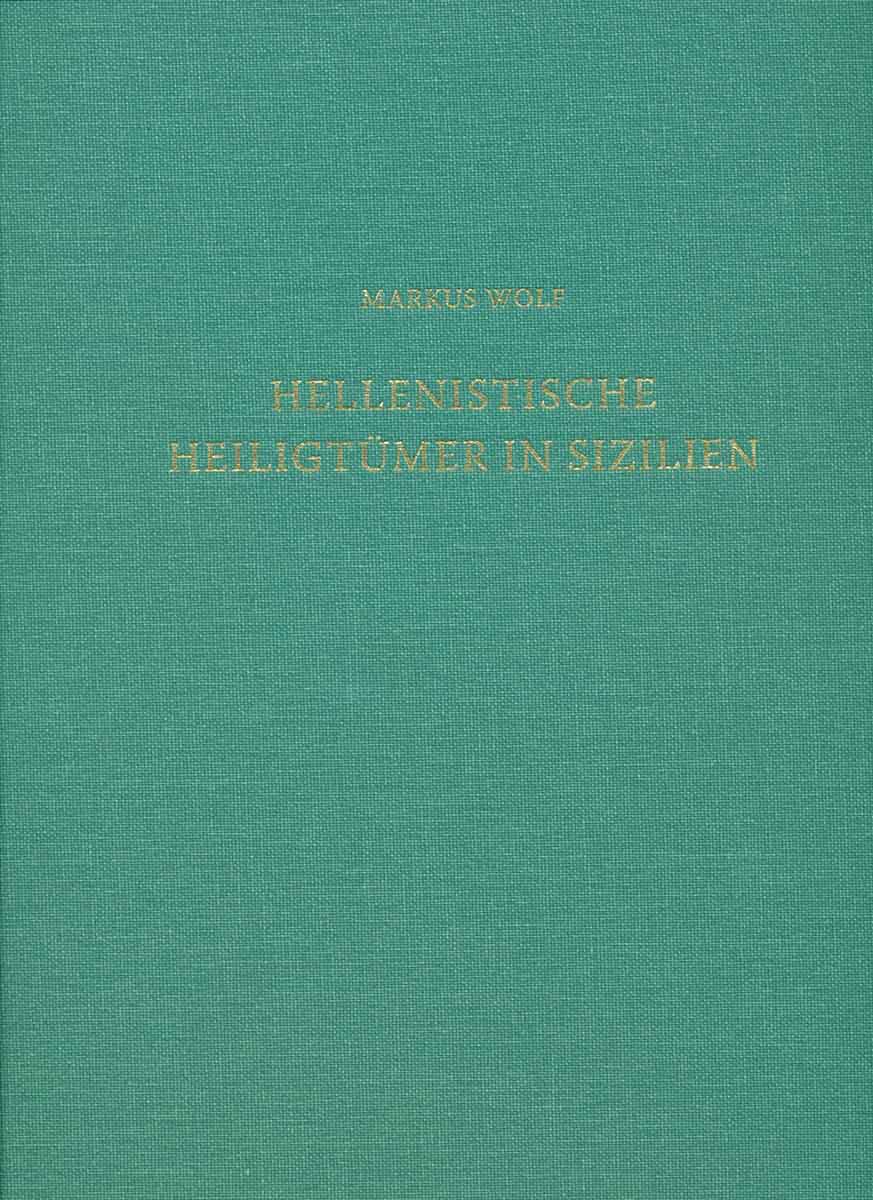
In his new book, Markus Wolf presents the results of his detailed studies of Hellenistic sanctuaries across Sicily, in Tauromenion, Syracuse, Heloros, and Agrigentum. The buildings have been given new architectural surveys and suggestions for reconstruction. In doing so, Wolf associates the Greek-influenced monuments in eastern Sicily with the kingdom of Hiero II, the last of the Greek kingdoms in Sicily. The Italian-Roman podium temple in Agrigentum, meanwhile, is differentiated strongly from the other structures. Following these studies, a comprehensive, comparative section of the book incorporates all the Hellenistic sanctuaries in Sicily into the study. Beyond this, it also draws connections to similar facilities in the Greek homeland and across Asia Minor, rendering a more comprehensive picture of sacral architecture in Hellenistic times.
The most recent study by Markus Wolf revolves around new architectural surveys of five Hellenistic sanctuaries in Sicily: the temples of Santa Caterina and San Pancrazio in Tauromenion, the large altar of Hiero II in Syracuse, the sanctuary of Demeter in Heloros, and the so-called Oratorium of Phalaris in Agrigentum. By applying the methods of archaeological building research, Wolf is able to propose new approaches to reconstructing the buildings and suggest new ideas on how they should be classified both chronologically and typologically. The monuments of Tauromenion, Syracuse, and Heloros in eastern Sicily suggest a strong Greek influence and are doubtlessly associated with the personality of the ruler Hiero II and his politics of building. Hiero II constructed a network of new sanctuaries in his capital city of Syracuse and the other cities of his kingdom – the last Greek kingdom in Sicily during the highpoint of the Hellenistic age. The most important building in this respect is the large altar in Syracuse, whose length of 199.45 meters makes it the largest altar of the ancient world. With its offset square to the west, surrounded by halls, in addition to sacrificing oxen it could also be used for larger gatherings. This made the altar into the center of Hiero II’s kingdom.
The so-called Oratorium of Phalaris in Agrigentum, in contrast, represents the situation outside of the Greek Kingdom of Hiero II in the other parts of Sicily that were already Roman provinces by this point in time. Here, a podium temple with an open staircase represents a specifically Italian-Roman approach to sacral architecture, influenced by the new Roman politics of building. By taking a comprehensive view, Wolf goes on to incorporate all the other Hellenistic sanctuaries in Sicily into his study. His comparative approach makes it possible to elaborate the varied cultural influences – Greek, Italian-Roman, and Punic – at play in a time during which Sicily found itself in a field of tension between various cultures and populations.
From here, the work draws connections to similar facilities in central and southern Italy, in the Greek homeland, and in Asia Minor, in order to render a more comprehensive picture and a new overview of sacral architecture in Hellenistic times. Beyond considering the monuments themselves, the study also lays an important foundation for studying the Hellenistic age from the perspective of other disciplines like classical archaeology or ancient history.
„[T]his study will be used for a long time by scholars of Hellenistic Sicily.“
Von: Lorenzo Campagna
In: sehpunkte 18 (2018), Nr. 2 [15.02.2018], URL:
http://www.sehpunkte.de/2018/02/30525html.
--------------------------------------
„Markus Wolf hat sich das große Verdienst erworben, fünf aus unterschiedlichen Gründen sehr interessante Bauten in adäquater Form vorgestellt zu haben. Die Beschreibungen sind durchweg ausführlich [...]. Die Rekonstruktionen sind fundiert und überzeugen. [...] Die Vorlage der Bauten ist wichitg und gelungen , es ist keine Frage, dass der Band in jede Fachbibliothek gehört.“
Von: Prof. Dr. Torsten Mattern (Universität Trier)
In: Göttinger Forum für Altertumswissenschaft 20 (2017) 1199-1204;
http://gfa.gbv.de/dr,gfa,020,2017,r,27.pdf;
DOI: 10.14628/GFA_020_2017_R27
-------------------------------
„Es ist ein grosses Verdienst des Verfassers, durch seine detaillierte Bauuntersuchungen die Grundlagen für weiterführende Diskussionen zur Tempelarchitektur auf Sizilien in hellenistischer und spätrepublikanischer Zeit geliefert zu haben.“
Von Christoph Reus
In: Museum Helveticum 76/1 (2019), S. 118-144
-------------------------------
„Markus Wolf hat sich bereits in zwei monographischen Studien zu den Wohnhäusern und zur Agora von Solunt (publiziert 2003 und 2013 in den Sonderschriften des Deutschen Archäologischen Instituts Rom) und in einer Reihe umfangreicher Aufsätze um die Aufnahme und Vorlage hellenistischer Architektur auf Sizilien und in Unter- und Mittelitalien verdient gemacht. Der hier anzuzeigende Band zu hellenistischen Heiligtümern auf Sizilien fügt diesem eindrucksvollen Œuvre einen weiteren bedeutenden Beitrag hinzu. (...) Es ist tatsächlich heilsam, mehr als hundert Jahre nach Delbrueck ein Werk zu sizilischer Architektur des Hellenismus in der Hand zu halten, das sich durch gewissenhafte Vorlage und Diskussion konkreter Bauwerke beharrlich auf sein kernthema konzentriert und sich nicht im endlosen Mahlstrom der Theoriediskussion, zwischen Skylla und Charybdis der Kulturmodelle, zerreiben lässt.
Von Dominik Maschek
In: GNOMON Kritische Zeitschrift für die gesamte klassische Altertumswissenschaft Bd. 92, Heft 1, S. 66-70
Dr.-Ing. habil. Markus Wolf, born in 1965, studied architecture and building history at the Technical University of Munich, and studied historical monument preservation at the University of Bamberg. While working in the building history department at the BTU Cottbus, he wrote his dissertation on the houses of Soluntum, for which he received his doctorate in 2000. After this, he spent many years researching at the Deutsches Archäologisches Institut in Rome, with projects on temple construction in Pompeii (on which he wrote his habilitation in 2005), on the agora in Soluntum, and on Hellenistic sanctuaries in Sicily. Currently, he is working on Hellenistic altars and sanctuaries in Campania. His research focus is on Hellenistic architecture in southern Italy.
Seit 1973 erscheinen in der renommierten Reihe „Sonderschriften des Deutschen Archäologischen Instituts Rom“ Monographien zu bedeutenden Forschungen in Italien und Nordafrika. In Vorbereitung sind Studien zu herausragenden Bauten der griechisch-römischen Antike wie dem Poseidontempel in Paestum, den Befestigungen des antiken Syrakus oder dem Kolosseum in Rom.
 Sample